Hopper Bird Feeders: What They Are and How to Choose One (2026)
A hopper bird feeder stores seed in a roofed reservoir and releases it onto a tray as birds eat. This gravity-fed layout can serve a mixed group of seed-eating birds, but its exposed tray and stored seed still need regular inspection. Cornell Lab’s feeder-type guide describes both the range of visitors and the limits of [...]
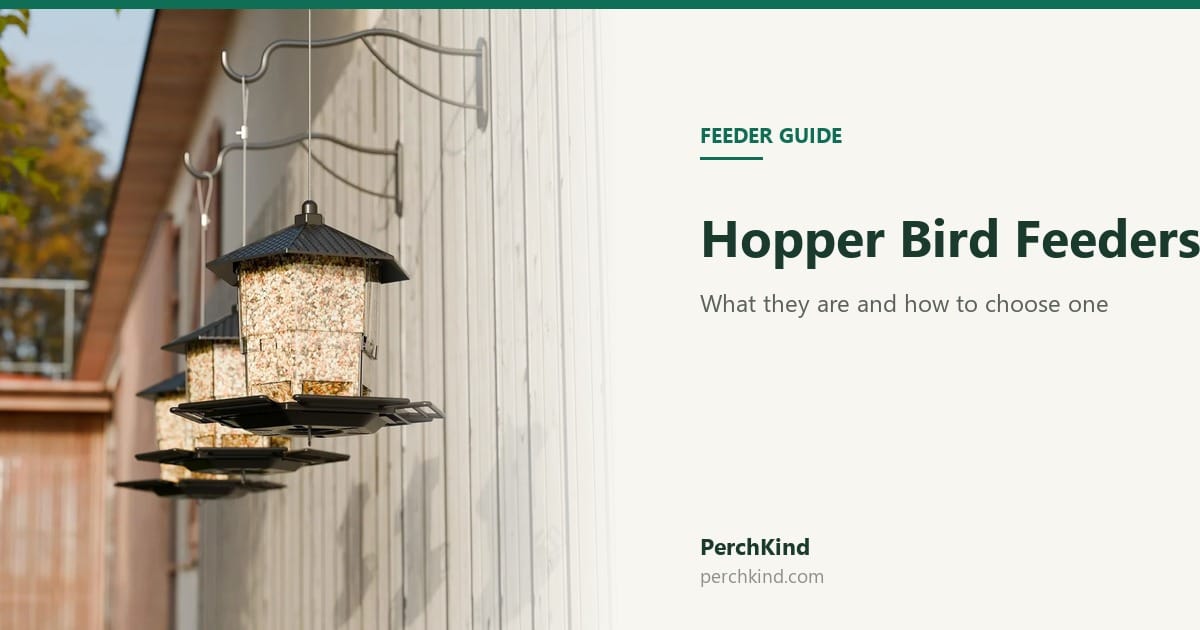
A hopper bird feeder stores seed in a roofed reservoir and releases it onto a tray as birds eat. This gravity-fed layout can serve a mixed group of seed-eating birds, but its exposed tray and stored seed still need regular inspection. Cornell Lab’s feeder-type guide describes both the range of visitors and the limits of its rain protection.
The trade-off is access versus protection. An open hopper tray can suit larger birds that cannot use short tube perches, but can also admit squirrels and unwanted visitors. Damp seed left in any feeder can spoil; no style is automatically the cleanest or dirtiest.
This guide focuses on basic gravity-fed hoppers with accessible trays. A reservoir describes how seed is stored, not whether squirrels are excluded. Some models add access controls; assess those features and the mounting instructions separately from the hopper label.
Key takeaways
- A hopper feeder stores seed in a covered reservoir and dispenses it into an open tray by gravity.
- An open hopper tray can accommodate a variety of seed-eating birds; actual visitors depend on the food, region and design.
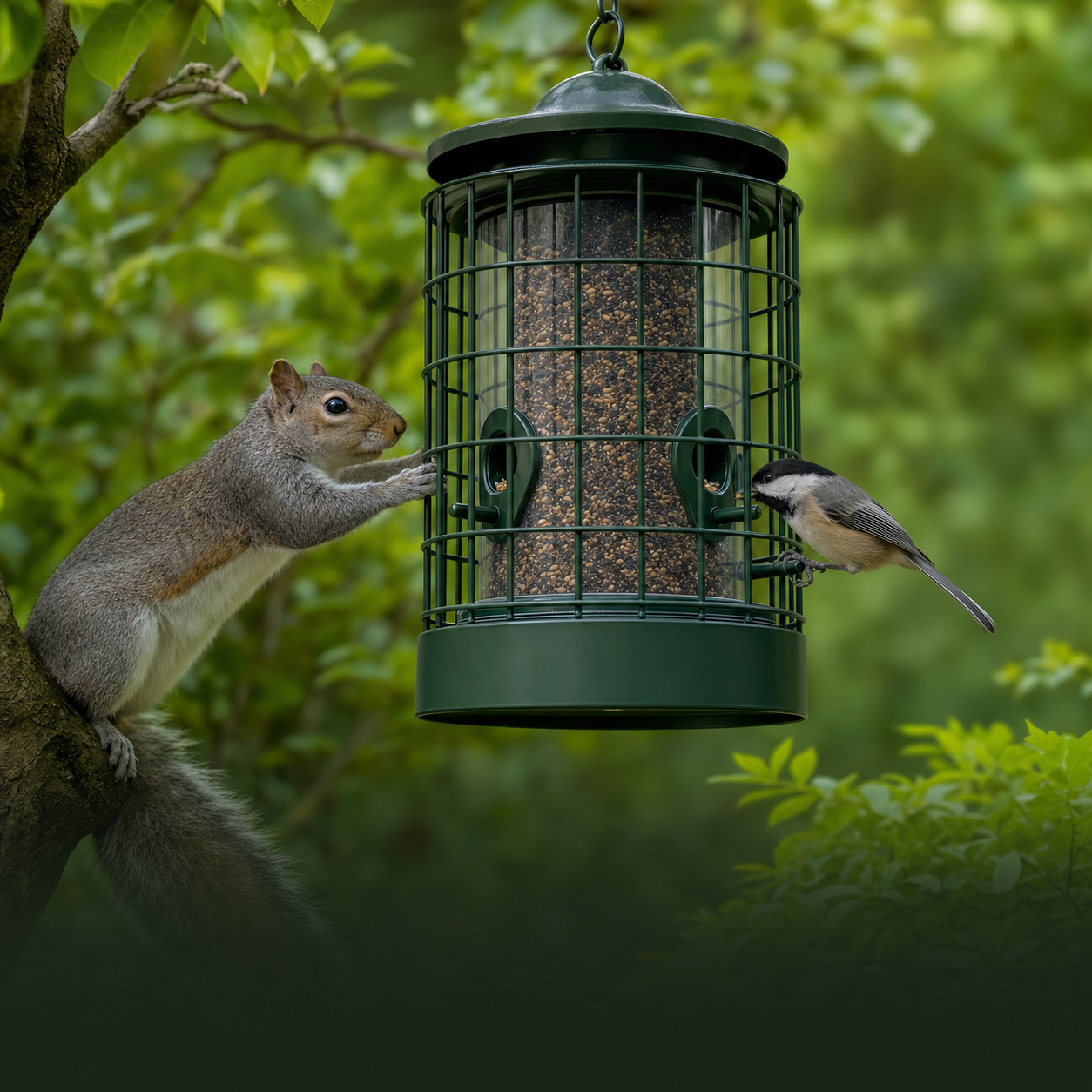
- A basic open tray is not a squirrel barrier. Check any model-specific access controls rather than assuming the hopper label guarantees protection.
- Moisture collects in the reservoir. Empty and dry it before refilling, or you are feeding mould.
- Capacity varies by model; a larger reservoir can mean fewer refills but more time for uneaten seed to spoil.
- Cornell Lab lists hopper feeders among the styles that attract the widest range of feeder birds.
What is a hopper bird feeder?
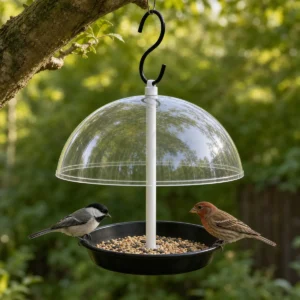
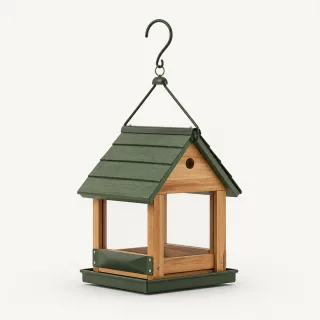
The name comes from the agricultural hopper — a funnel-shaped bin that feeds material downward. In a bird feeder, the hopper is the covered box or clear-sided reservoir that holds the seed. Below it sits a tray, usually with a low lip and sometimes a screen floor for drainage.
What one looks like
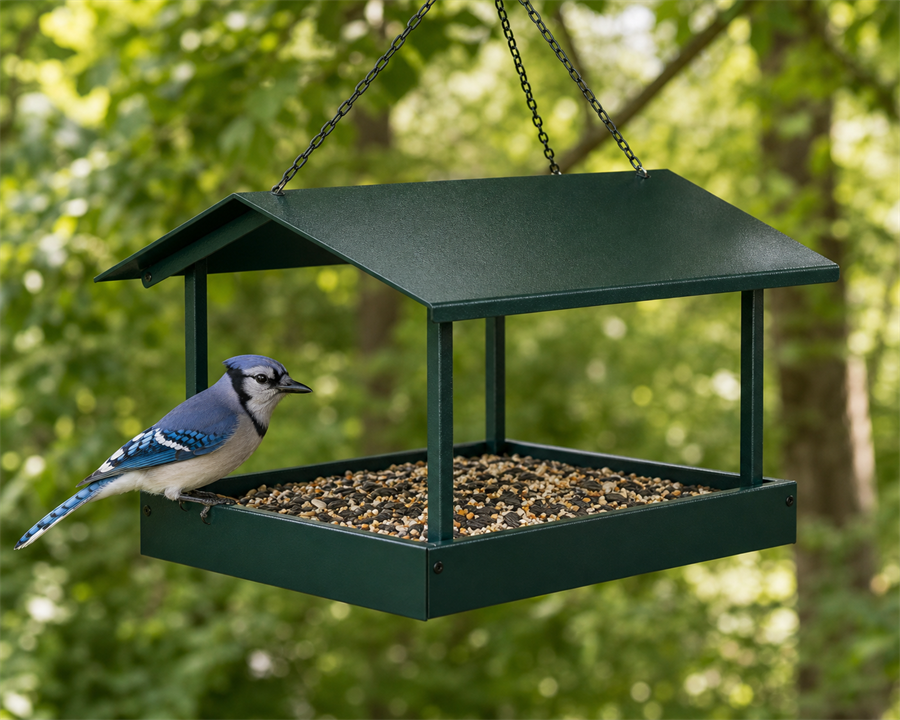
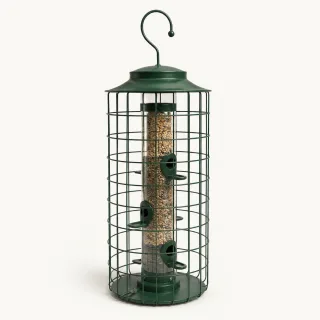
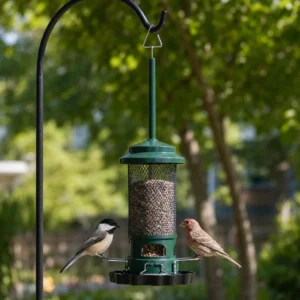
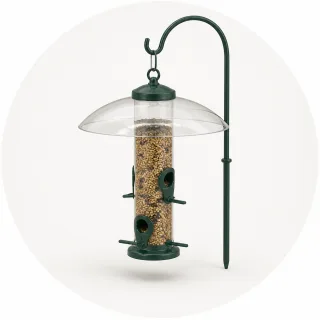
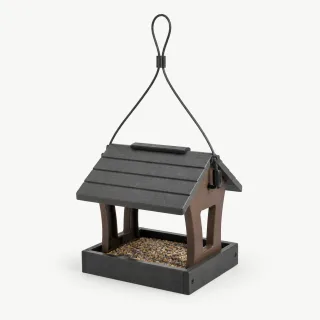
Most hopper feeders share the same anatomy: a roofed reservoir, often with clear panels so you can see the seed level, mounted above a shallow tray. Perches or a raised tray edge let birds settle while they eat. They are usually hung from a hook or bracket, or mounted on a pole.
What makes it different from a tube feeder
A tube feeder normally stores seed in a cylinder with feeding ports; a hopper feeds seed from a roofed reservoir onto a tray. Neither is necessarily airtight or weatherproof. Port size, perch layout, tray size and cleaning access matter more than the label alone.
How a hopper feeder works
Understanding the mechanism makes the maintenance rules obvious.
Gravity flow
Seed rests in the reservoir and falls through a gap at the bottom into the tray. As birds eat from the tray, more seed slides down to replace it. Basic gravity-fed models need no powered dispenser, but lids, hinges, hangers and feed openings still need inspection. Adjustable or weight-activated models may have additional moving parts.
Why the seed level drops evenly
In an unobstructed gravity-fed model, more seed moves toward the tray as food is removed. The pattern depends on the outlet and seed, and clumping or debris can interrupt it. Check the tray and reservoir rather than assuming an even rate of emptying.
What happens when seed gets wet
Wet seed swells, clumps and bridges across the feed gap, which stops the flow even though the reservoir looks full. Moisture is one possible cause of blocked seed flow; outlet size, seed size and debris can also contribute. Our guide to keeping bird seed dry covers the causes in detail.
Hopper vs tube vs platform feeders
All three work. The choice is about which birds you want and how much maintenance you will actually do.
| Feeder type | Key difference | Best suited to |
|---|---|---|
| Hopper | Covered reservoir feeding a tray; capacity and weather protection depend on the model | Mixed backyards with cardinals, jays, doves and finches; anyone who wants fewer refills |
| Tube | Cylinder with feeding ports; protection, access and waste depend on port and tray design | Finches, chickadees and titmice; yards where larger birds empty the feeder |
| Platform / tray | Open tray with no reservoir; no storage, full weather exposure | The widest bird variety including ground feeders; offering fruit, jelly or suet |
Compare actual models rather than assuming one style always holds more seed or wastes less. A hopper roof can reduce direct rain exposure, while a tube’s port and perch sizes influence access. For fruit or jelly, choose equipment designed for that food rather than filling a seed hopper with it.
Where a hopper feeder sits on squirrel resistance
A basic hopper with an accessible tray has no built-in barrier to a squirrel that reaches the food. Some hopper-style models add weight-responsive or other access controls; that does not stop them being hoppers. Check the exact mechanism, mounting requirements and possible access routes. Baffles and placement can complement model-specific controls, but the hopper label alone establishes no level of protection. See our squirrel-control guide for placement and baffle considerations.
What hopper feeders do well
They accommodate a variety of birds
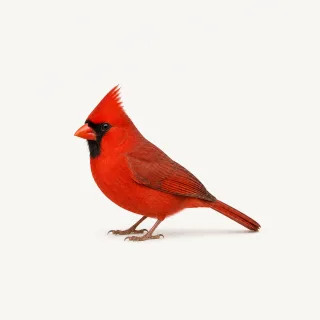
The open tray is the reason. A cardinal, a jay and a goldfinch cannot all use the same tube port, but all three can use the same tray. Cornell Lab’s feeder guidance lists hopper feeders among the styles that draw the broadest variety of backyard species.
They hold enough seed to matter
Read the stated capacity of each model. A larger reservoir may reduce refill frequency, but fill only an amount you can monitor and replace before it becomes damp or spoiled.
They shed rain reasonably well
The roof can reduce direct rain exposure. Wind-driven rain, condensation and blocked drainage can still leave food damp; inspect the actual model after wet weather.
Basic gravity flow can simplify use
Check the lid, hanger, hinges, tray finish and feed gap regularly. A simple gravity path does not make a feeder maintenance-free or prevent blockages.
The real limitations
These common trade-offs are worth checking against the actual model. Roof overhang, outlet design, cleaning access and squirrel-control features can differ.
An open tray is not a squirrel barrier
For a basic open-tray hopper, consider appropriate baffles and placement. For a model with additional access controls, follow its instructions too. Do not assume either a roof or a gravity-fed reservoir makes the feeder squirrel-proof.
Larger birds can empty it
Starlings, grackles and doves can all use a hopper tray, and they arrive in groups. If your feeder is being cleared by larger birds, a tube with small ports is the more effective fix.
Seed can sit long enough to spoil
Stored seed can remain outside longer than you intend. Fill less if food is left uneaten or becomes damp, and remove spoiled seed rather than topping it up. Do not use capacity or a fixed week count as proof of freshness.
What to put in a hopper feeder
Use dry seed compatible with the manufacturer’s outlet design. A seed hopper is not a container for nectar, jelly or other wet food.
Best choices
Black-oil sunflower is a useful starting food for many North American seed-eating birds; Cornell Lab’s seed guide explains its thin shell and broad appeal. It is not a freshness guarantee or proof that it outperforms every blend.
What to avoid
Check a blend’s ingredients against the birds you actually see. Cornell Lab’s seed guide distinguishes frequently wasted fillers from useful foods and notes that milo can suit some western birds. Not every blend is poor, and no single seed suits every regional visitor.
Keep the seed level moderate
Start with a modest amount that you can inspect and use before it deteriorates. There is no universal two-thirds fill rule; follow model instructions and adjust to consumption and weather.
Where to hang or mount one
Placement decisions for a hopper feeder are mostly about access — yours and the squirrels’.
- Reachable for refilling. Chest to head height (4–6 feet / 1.2–1.8 m) is comfortable to fill and easy to inspect. If you cannot check the reservoir easily, you will not.
- 10–15 feet (3–5 m) from cover. Birds want a safe route to a shrub or tree, but a branch right beside the feeder gives squirrels a launch pad. Split the difference.
- Keep clearance from branches, fences, roofs and other launch routes where possible. Observe the actual route squirrels use; clearance works with suitable baffles and model-specific controls, not as a guaranteed standalone solution.
- Window-safe. Treat hazardous glass with closely spaced exterior markings or an exterior screen. Feeder or birdbath distance alone does not prevent collisions. Our feeder placement guide covers the reasoning.
- Choose shelter without sacrificing safe access, glass safety or visibility of predators. Check food condition regardless of shade; a sunny or shaded location does not establish freshness.
Keeping seed dry and the feeder clean
Check at every refill
Check the tray for clumping, and tip out anything damp. Check the feed gap for bridged seed. Empty and dry the reservoir if you see condensation inside the clear panels — that is the warning sign.
Regular cleaning, not just monthly maintenance
Clean seed feeders about every week or two, more often in wet weather or heavy use. Empty the feeder, follow its material-specific cleaning instructions, and dry it fully before refilling. Inspect hardware separately; a monthly hardware check does not replace regular cleaning. Our bird feeder cleaning guide covers the disinfecting ratios and the step-by-step routine. See Project FeederWatch’s feeding guidance.
Never top up over old seed
If the seed in the reservoir is damp, clumped or smells musty, adding fresh seed on top does not fix it — it buries the problem where you cannot see it. Empty it, dry it, start again. This is the single habit that separates a healthy hopper feeder from a sick one.
Rake underneath
Hopper feeders scatter hulls and rejected filler seed below them, and birds feed on the ground in that debris. Rake it up regularly — accumulated spoiled seed under a feeder is a disease reservoir.
Hopper feeder mistakes to avoid
Filling it to the top in a quiet yard
Capacity is only useful when seed is eaten quickly. In a quiet yard, a full reservoir may leave seed outside longer than necessary. Start with less and adjust to actual use and seed condition.
Using a general wild bird mix
Review what is left uneaten. Choose ingredients for your local birds instead of assuming every blend, or every grain such as milo, is unsuitable.
Assuming the roof means the seed is dry
A roof keeps rain off but does not seal the reservoir. Humid air still enters, and clear-sided hoppers show condensation long before the seed looks wrong.
Treating it as squirrel-proof
Do not assume squirrel protection from the hopper label. Check the actual access-control features, mounting requirements and routes from nearby structures.
Never emptying the reservoir
Topping up can conceal damp food beneath a fresh-looking layer. Empty contaminated seed, clean and dry the feeder, and refill with fresh food.
Quick hopper setup checklist
- ☐ Clear-sided reservoir so you can see the seed level
- ☐ Removable or wide-mouth top for easy filling
- ☐ Drainage in the tray, not just in the reservoir
- ☐ Refill amount matched to consumption, weather and model instructions
- ☐ Fresh seed or a blend suited to local birds and the model’s openings
- ☐ Hung 10–15 feet (3–5 m) from cover, clear of fences and branches
- ☐ Hazardous windows treated on the outside; no distance-only safety rule
- ☐ Any squirrel controls assessed for the exact model and mounting location
- ☐ Inspect at every refill; clean every week or two, sooner when conditions require
- ☐ Ground beneath the feeder raked regularly
Frequently asked questions
What is a hopper bird feeder?
A bird feeder with a covered reservoir that stores seed and dispenses it into an open tray below by gravity. Birds feed from the tray, and seed trickles down from the reservoir to replace what is eaten. It is one of the most versatile feeder designs because the open tray suits a wide range of bird sizes.
Are hopper feeders better than tube feeders?
Neither style is always better. Compare actual capacity, feeding access, rain exposure and cleaning access. An open hopper tray can accommodate larger birds; some small-port tube designs limit access. Refill frequency and waste depend on the model, food and birds using it.
Do hopper feeders keep seed dry?
A roof can reduce direct rain exposure, but does not guarantee dry seed. Wind-driven rain, humidity and condensation can still cause problems. Compare roof and drainage details on the actual model, and inspect seed and feed openings at every refill.
Are hopper feeders squirrel-proof?
Not by definition. A basic open-tray hopper allows access to a squirrel that can reach the food. Some models add weight-responsive or other access controls. Check the exact model’s instructions, use suitable mounting and baffles where appropriate, and do not infer guaranteed protection from the hopper label.
What is the best seed for a hopper feeder?
Black-oil sunflower is a useful starting choice for many North American feeder birds. Choose fresh seed or a blend suited to the birds present and the model’s openings. Milo and other ingredients have regional uses; do not judge every blend by the same rule.
How often should a hopper feeder be refilled?
Refill when the reservoir is low, but only after checking that the remaining seed is dry and loose. If the seed is clumped or musty, empty the feeder completely and dry it before adding fresh seed rather than topping it up.
Why is seed not coming out of my hopper feeder?
Check for damp or clumped seed, debris, and seed that is too large for the outlet. Empty the feeder, clean and dry it, then use fresh seed compatible with its openings. Follow the manufacturer’s instructions; do not enlarge drainage or feed openings without approval.
Can I hang a hopper feeder or does it need a pole?
Both work. Hanging is simpler and fine if the branch or bracket is sturdy and the feeder is clear of squirrel launch points. A pole gives you more control over height and lets you fit a baffle below, which is the more effective arrangement if squirrels are already a problem.
Choosing a hopper feeder that fits how you actually feed birds
A hopper feeder can suit a mixed group of seed-eating birds when its tray, food and placement match their needs. Check seed condition frequently, remove damp or spoiled food, and clean and dry the feeder before refilling. No feeder style guarantees the most visitors in every yard.
PerchKind stocks hopper bird feeders built around the features that actually matter in daily use — a protected reservoir, a wide perch tray, drainage where moisture collects, and an adjustable hanging setup so you can set the height. Browse the full bird feeder collection, or start with the adjustable hanging hopper bird feeder with a wide perch tray, which lets you compare capacity and dimensions against your own yard before committing to a location.
For how hopper feeders compare with every other style, see our bird feeder guide. If you are choosing seed rather than a feeder, what to put in a platform feeder covers food by species, and finch feeders compares sunflower, nyjer and suitable feeder openings. Everything else is collected under birding guides.
Sources and editorial notes
- Cornell Lab of Ornithology, All About Birds — How to Choose the Right Kind of Bird Feeder (feeder styles and the birds each serves)
- Cornell Lab of Ornithology, Project FeederWatch — Feeding Birds (seed selection, feeder maintenance and hygiene)
- Cornell Lab of Ornithology, Project FeederWatch — Common Feeder Birds (which species use which feeder types)
Written for PerchKind. Feeder selection and maintenance recommendations follow Cornell Lab of Ornithology and Project FeederWatch guidance. Measurements are given in both imperial and metric. Hopper feeder capacity, materials and mounting options vary by model — check the product page for specific dimensions before choosing a location.
Editorial correction, 21 October 2026: Food choices, species scope and model-specific claims have been aligned across the article and FAQ. This guide reports no independent product or bird-attendance trial.