Birds Not Using Your New Feeder? Check the Symptom First
Separate no visits from no feeding, check food access and safety, and change one suitable variable before deciding whether a different feeder is needed.
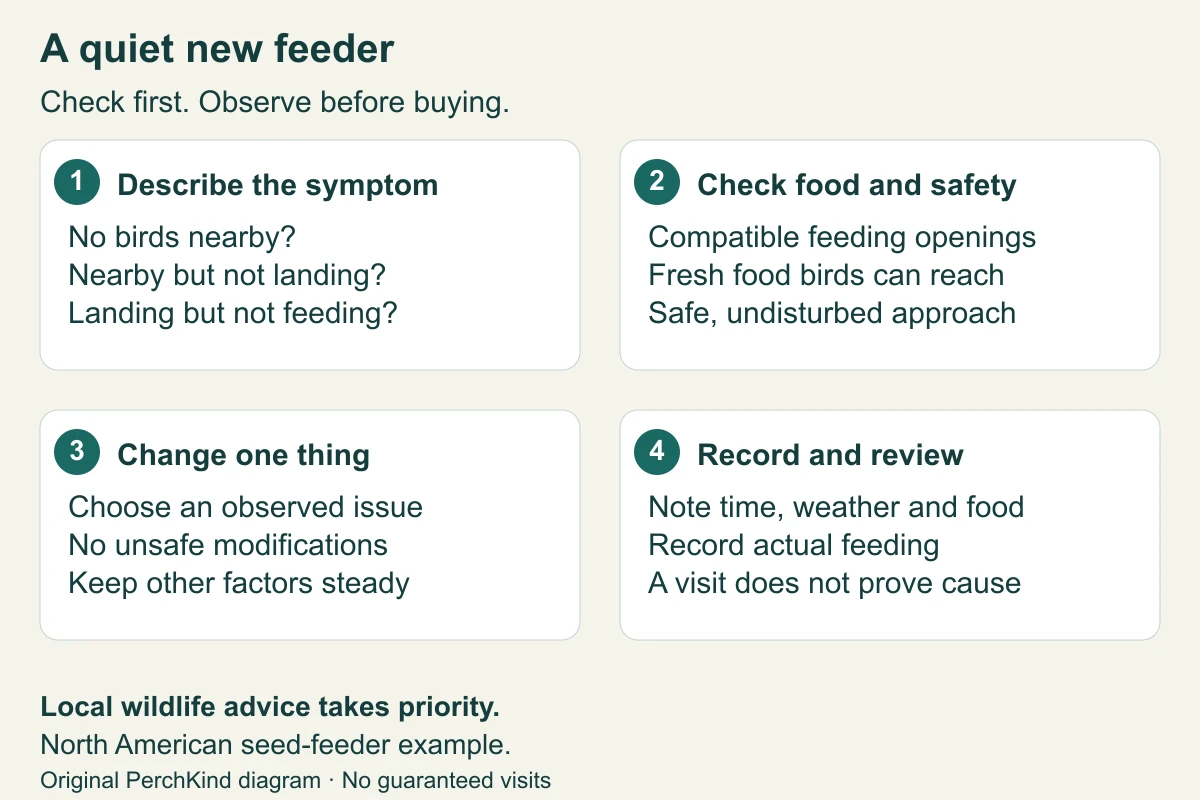
If birds are not using your new feeder, check whether food is actually reachable, whether it suits birds already in your area, and whether the approach is safe. Then keep a suitable setup steady while you observe it. An untouched feeder does not, by itself, prove that the feeder is defective or that its color is wrong.
This troubleshooting guide focuses on seed feeders in the United States and Canada. Local wildlife advisories take priority. In the UK, current RSPB advice is different: pause seed and peanut feeding from 1 May to 31 October and avoid flat-surface feeders. Do not apply a North American tray-feeding example as a UK recommendation.
First distinguish a new feeder from a station that went quiet
Before buying another feeder, distinguish a station that has never been visited from one that suddenly became quiet. Write down what you can actually see, rather than treating every missing visitor as the same problem.
| What you observe | First check | What it does not prove |
|---|---|---|
| No birds near the feeding area | Local birds, habitat and seasonal activity | That a larger feeder will attract them |
| Birds nearby but none landing | Clear access, disturbance and feeder fit | That the decorative color is the cause |
| Birds land but do not take food | Accessible food, freshness and port compatibility | That more seed will solve the problem |
| Food disappears without observed visits | Spillage, empty hulls and other visitors | Which bird species ate it |
| A previously used feeder goes quiet | Recent changes, natural food and predators | That the feeder suddenly stopped working |

Use the first three rows for a new feeder. The last row is a different starting point: Project FeederWatch identifies habitat, weather, natural food and predators as possible reasons for changing numbers. None can be diagnosed from a single quiet morning.
Check whether food reaches the tray or feeding ports
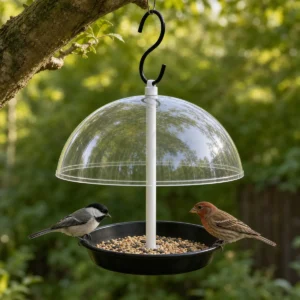
Inspect an empty feeder first. Confirm that it is assembled according to its instructions, that feeding openings are unobstructed, and that the hanger or support is secure. Do not enlarge holes, bypass a moving mechanism, or improvise a modification to force access.
Add a small amount of the intended food. Can it reach the feeding area? A reservoir can look full while the ports or tray remain empty. Check for damp clumps and ingredients too large for the opening. If the mechanism is unclear, ask the seller before changing it.
Food choice and feeder design work together. Cornell Lab’s seed guide describes black-oil sunflower as suitable for many seed-eating birds. Project FeederWatch explains that Nyjer needs small feeding ports to reduce spillage; it is not interchangeable with every seed mixture. Nectar, fruit and jelly need their own suitable serving arrangements rather than being poured into a seed reservoir.
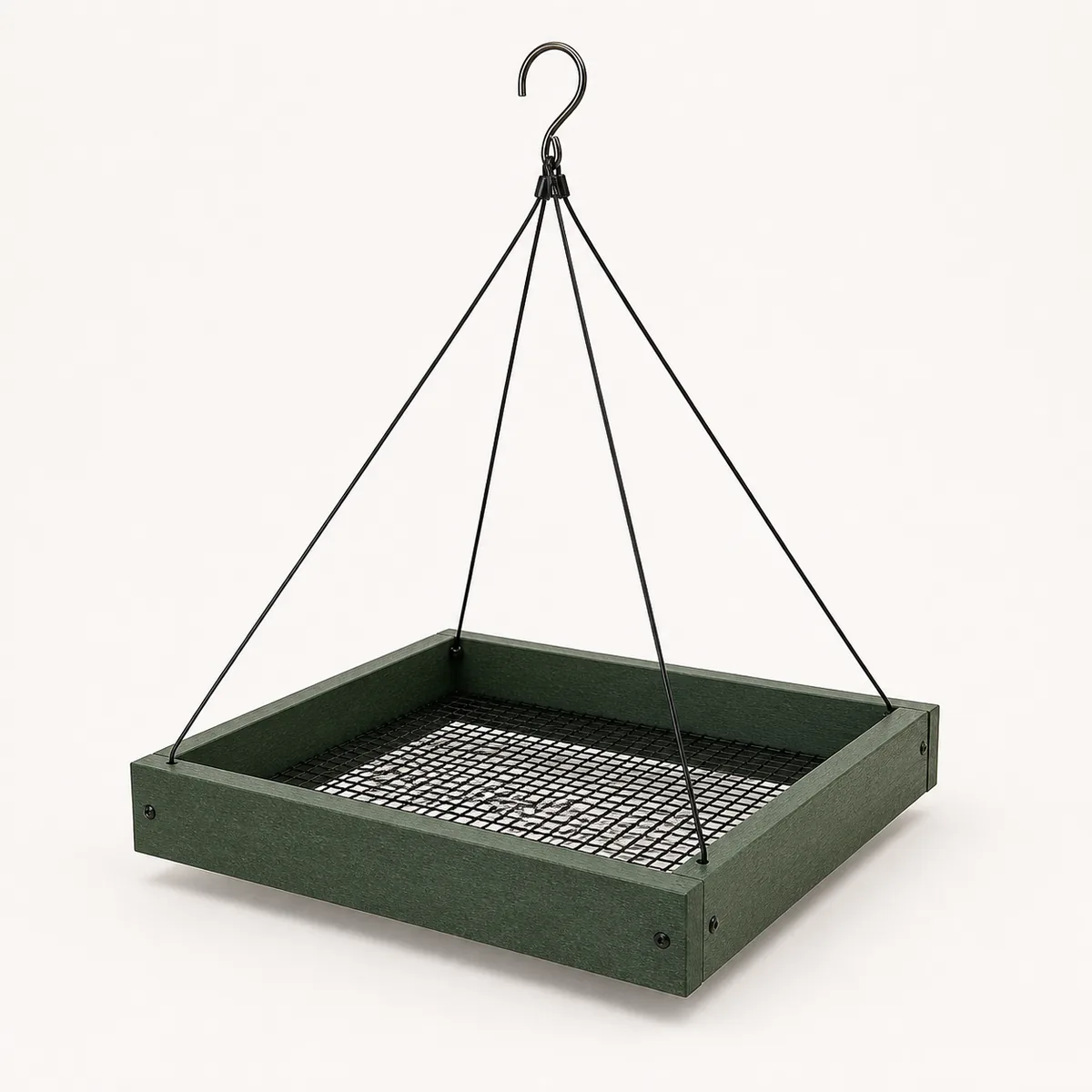
Offer one compatible food initially. That makes leftovers easier to interpret. If you are filling a platform, our platform food guide explains presentation and small servings. It is not a requirement to use a tray when another design better suits your local guidance.
Match food access to the birds and approach you observe
Observe from indoors or another unobtrusive position. Are birds using nearby vegetation? Do they approach and turn away? Is someone repeatedly passing the station, or is a cat waiting beside it? A description of those events is more useful than “birds do not like this feeder.”
Watch for nearby shelter, predator access and exposed feeding positions rather than selecting a spot only for your view. Wind-blown or wet food is a reason to inspect exposure. Before any move, address reflective glass: Project FeederWatch recommends exterior window markings or screens. A more visible feeder is not automatically a safer one.
Use the bird feeder placement guide for window precautions, cover and mounting. This page helps you choose what to investigate next, rather than repeating every placement measurement.
Check safety and food condition before waiting longer
Look for edible seed, not just the apparent depth of material. Empty hulls can hide what remains. Check food at the bottom of a reservoir as well as the visible tray, and do not add fresh seed over old debris.
Remove spoiled or contaminated food and clean and dry the feeder before reuse. Project FeederWatch’s safety guidance explains why removing debris and drying cleaned parts matter. Our cleaning guide covers materials and cleaning steps; the wet-seed guide covers rain entry and drainage. Neither drainage holes nor a roof makes food safe to leave unchecked.
If birds appear ill, stop treating low attendance as an attraction problem. Seek current advice from your local wildlife authority; appearance alone does not identify a disease. FeederWatch’s sick-bird guidance explains why feeding or removal decisions may depend on the disease and nearby feeding activity. Never keep an attraction trial running through a local instruction to suspend feeding.
Record one suitable change without assuming it caused a visit
Once immediate hazards and maintenance problems are addressed, choose one adjustment that matches your observation. For example, inaccessible seed calls for a compatibility check—not simultaneously changing food, location and feeder style. Birds turning away during regular disturbance call for a quieter approach—not a bigger reservoir.
Use a short note like this:
- Record the date, approximate observation time and weather.
- Note birds nearby, landings and visible feeding separately.
- Describe the food condition and whether it reaches the feeding area.
- Write down the single change you made and why.
- Compare later observations taken under similar conditions where practical.
This is a household observation routine, not an experiment proving cause and effect. A visit after a change may be encouraging, but weather, bird movements and other food sources may also have changed. Keep unsafe or contaminated food out of the station regardless of the observation plan.
Do not keep changing a safe new feeder merely because a short watch was unsuccessful. Allow further observations after checking access, food condition and nearby birds. This is a practical troubleshooting approach, not a validated waiting schedule; it does not establish a deadline after which no visits means failure.
When a different feeder solves a specific mismatch
A replacement makes sense when you identify a specific mismatch you cannot safely correct: incompatible ports, inaccessible cleaning surfaces, damaged parts, or a landing arrangement unsuitable for the birds you actually observe. “No visitors yet” is not a complete product specification.
Compare designs in our bird feeder guide only after naming the need. A second feeder should solve that need without creating more maintenance than you can manage. PerchKind sells feeders, but buying another model is not always the right next step.
Questions about waiting, scattered seed and missing food
How long should I wait for birds to find a new feeder?
There is no reliable deadline for every yard. Check immediate safety, accessible fresh food and local bird activity first. Continue observing a suitable setup rather than expecting a guaranteed first visit on a particular day.
Should I scatter seed to advertise the feeder?
Do not make ground scattering your default fix. FeederWatch warns that food on the ground can attract rodents; it also adds food and waste to manage. Local feeding guidance, contamination and unwanted visitors matter more than making the station conspicuous.
Does an empty feeder mean birds used it?
Not necessarily. Check for food falling through openings, wind loss and other animals. Directly observed feeding is different from a changed food level.
What if there are birds nearby but they ignore the seed?
Identify the birds if you can, then check food and access against their needs. Birds feeding in plants are not necessarily interested in your chosen seed. Avoid changing several parts of the setup at once.
Editorial notes
Prepared by the PerchKind Editorial Team using Cornell Lab and Project FeederWatch guidance. The diagnostic table and observation routine are editorial tools, not results of a feeding trial or promises about attendance. Regional advice may change. For product assembly questions or corrections, contact PerchKind.