


Solar Bird Bath Fountains: How They Work and How to Choose One (2026)
A solar bird bath fountain uses a photovoltaic panel to power a water pump, sometimes with battery storage and a cable to a separate panel. Compare the exact model’s light requirements, water-depth needs and cleaning access before buying. Solar power alone does not guarantee continuous operation. For bath types, placement and routine care beyond the [...]
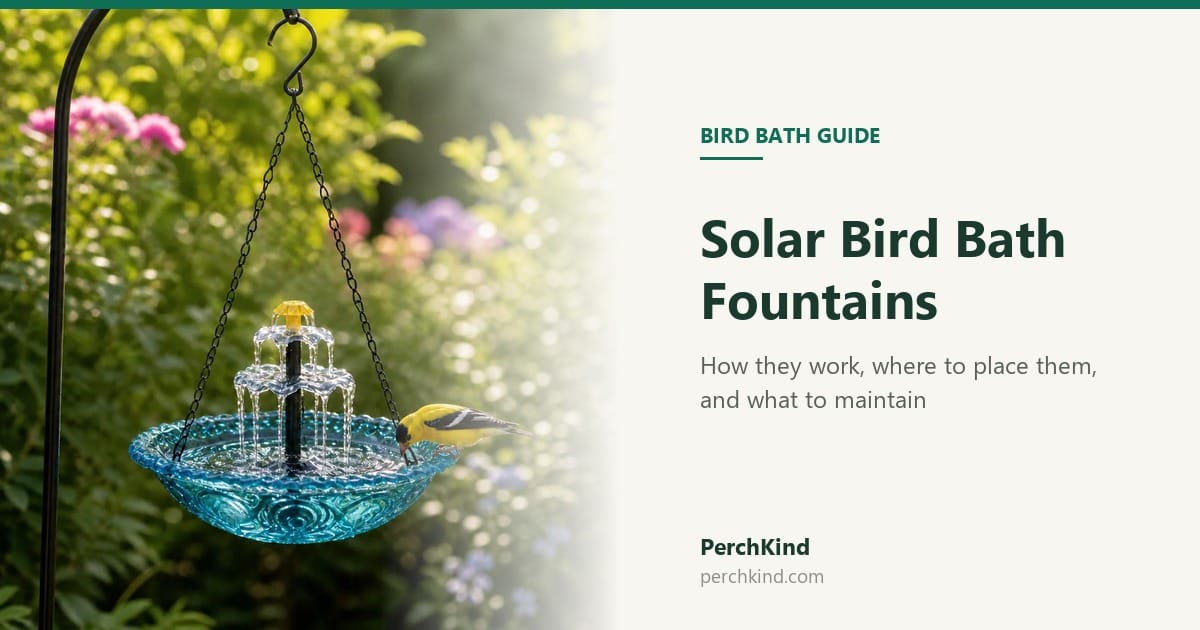
A solar bird bath fountain uses a photovoltaic panel to power a water pump, sometimes with battery storage and a cable to a separate panel. Compare the exact model’s light requirements, water-depth needs and cleaning access before buying. Solar power alone does not guarantee continuous operation.
For bath types, placement and routine care beyond the pump, see our bird bath guide.
A direct-solar pump depends on light reaching its panel and may slow or stop when that panel is shaded. Battery-backed systems may continue on stored energy, and a separate panel can sit in sun while the basin stays shaded. Check the model’s actual design; do not assume one operating pattern for every solar fountain.
This guide covers solar-powered fountains and fountain baths. If your spot is shaded for most of the day, a mains-powered pump or a dripper is a different solution — the same principles about water depth and placement still apply, but the power section will not.
Key takeaways
- Solar fountains use a panel to power a pump, sometimes with battery storage. Some use a cable between panel and basin; check the specification rather than assuming no wiring or maintenance costs.
- Check whether the model includes a battery and what conditions its stated runtime assumes. Stored energy and solar charging vary; no universal one- or two-hour backup duration is established here.
- Compare panel requirements, pump demand, placement and any battery together. No four- or six-hour sunlight threshold guarantees operation for every model.
- Moving water attracts birds because they locate water by sound and movement, not by sight alone.
- Birds need shallow water — no more than 1 inch at the edge and 2 inches in the centre — to bathe safely.
- Poor flow can have several causes, including insufficient panel light, low water, debris, a blocked intake or a pump fault; use the model’s troubleshooting sequence.
How a solar bird bath fountain works
Three parts do all the work: a photovoltaic panel, a low-voltage pump, and a nozzle or spray head.
The panel converts sunlight into direct current. That current drives the pump, which pulls water from the basin and pushes it back out through the nozzle. Because the pump runs on whatever the panel produces in that moment, output rises and falls with the light. There is no reservoir of stored energy in a basic unit — the sun is the fuel line.
Why most units have no battery
A direct-solar system cannot continue indefinitely without adequate light or stored energy. In a remote-panel design, a shaded basin is different from a shaded panel; check both locations.
What the panel rating actually tells you
A panel rating alone does not predict flow in your yard. Check the manufacturer’s light requirements, pump power demand, battery specification and panel placement. Observe shade during the day; this guide has not tested a universal wattage comparison or minimum number of sunlight hours.
How moving water may help birds notice a bath
A gentle dripper or fountain may help birds notice a water source. Birds can also drink and bathe in still water; movement does not prove that water is clean or shallow. See Cornell Lab’s birdbath guidance.
Choose a pump for the movement you want and the maintenance you can provide, not a guaranteed increase in bird visits. Keep a usable shallow area clear of the pump and watch whether birds use it.
Depth is a safety issue, not a style choice
Bathing birds need stable footing in shallow water. Use water no deeper than 1 inch (2.5 cm) at the edge, gently sloping to a maximum of 2 inches (5 cm) in the centre. See Cornell Lab’s birdbath guidance.
If your existing bath is too deep, a stack of flat stones or a purpose-made shallow insert fixes it without replacing the basin. This is one of the cheapest improvements you can make to a bird bath, and it takes about a minute.
Types of solar bird bath fountains
Four formats cover almost everything on the market. The right one depends on whether you already own a basin and how much space you have.
| Type | How it mounts | Best for |
|---|---|---|
| Floating fountain | Floats in a basin compatible with the unit’s diameter, depth and intake requirements | Upgrading a bath you already own; the cheapest entry point |
| Integrated fountain bath | Pump built into the basin itself | A single tidy unit; no separate parts to store |
| Hanging fountain bath | Hangs from a bracket, hook or branch | Small yards, balconies, and keeping cats at a distance |
| Pedestal fountain bath | Freestanding column, panel on top or alongside | Open lawns with all-day sun; the classic look |
A floating unit is usually the smartest first purchase. It converts whatever basin you already have into a fountain, and if the pump disappoints you have lost very little. Integrated units suit anyone starting from scratch, while hanging and pedestal designs solve siting problems that a ground-level bath cannot.
Floating vs integrated: which suits your yard
A floating unit may suit a compatible existing basin; an integrated unit may be simpler when starting from scratch. Check safe mounting, usable bathing area, cleaning access and each component’s winter requirements. No format is universally cheaper, predator-proof or maintenance-free.
What to check before you buy
Six details decide whether a fountain is a pleasure or a chore. None of them show up in the marketing photos.
- Battery backup or not. Decide based on how much shade your spot gets, not on price alone.
- Nozzle options. Interchangeable heads let you tune spray height. Very tall spray loses more water to evaporation and drift, so you refill more often.
- Pump access. You will clean the impeller. If the pump is sealed inside the basin with no service access, maintenance becomes a genuine chore.
- Check whether an intake filter is supplied, removable and serviceable. Follow the manufacturer’s cleaning procedure; do not add an unapproved filter or claim a lifespan improvement without evidence.
- Basin depth at the rim. Check for a shallow, gently sloping area with stable footing.
- Panel cable length. If the panel is separate, the cable has to reach from the basin to full sun. Measure that distance before you buy, not after.
Use this as a question checklist, not a runtime prediction. A battery needs enough charging light and compatible electronics; storage cannot compensate indefinitely for an unsuitable panel location.
| Site condition | What to verify |
|---|---|
| Panel receives sustained direct sun | Manufacturer’s operating light requirements and pump demand |
| Panel is intermittently shaded | Actual battery capacity, charging assumptions and rated runtime, if storage is included |
| Basin is shaded most of the day | Whether a separate panel can reach sun within its rated cable length; otherwise consider a different water setup |
Where to place a solar bird bath fountain
Two constraints pull in opposite directions: the panel needs sun, and the birds need cover. Plan for both at the same time, because moving the bath later means re-levelling it.
- Place the panel according to the model’s light requirements. If it is separate, check cable reach; the basin can benefit from shade in warm weather.
- Keep useful escape cover nearby, while leaving open sightlines between the basin and places a cat could hide. No 10- or 30-foot cutoff guarantees visits or safety.
- Window safety: Treat hazardous glass with closely spaced exterior markings or an exterior screen. Feeder or birdbath distance alone does not prevent collisions.
- Predator sightlines: avoid spots where a cat can crouch unseen within a few feet of the basin.
- Level ground: a fountain that tilts will spill, and the pump will run dry and overheat.
Mounting options for small spaces
A suitably secured hanging or deck-mounted bath can suit limited floor space, but elevation alone is not protection from cats. Check support strength, access, sightlines and nearby glass. Our bird feeder guide covers broader station planning.
Keeping it running: maintenance
Maintain the basin and pump separately: wildlife-health guidance concerns clean water, while pump and electrical care must follow the exact model’s instructions. No failure-rate or product-lifespan data are claimed.
- Replace the water every day or two, sooner when dirty. A circulating pump does not replace water changes; Cornell Lab’s birdbath guidance explains why regular changes matter.
- Follow material-specific basin cleaning and disinfectant instructions. Remove or isolate the pump as its manual directs; do not immerse electrical parts or assume a basin-cleaning chemical is safe for pump seals. Rinse the basin thoroughly before refilling.
- If the model has a serviceable filter, inspect and clean it as instructed. A blockage is one possible cause of reduced flow, not proof that the pump is healthy.
- Top up daily in summer. Spray and evaporation can drop the level below the pump intake in a single hot day, and running dry shortens pump life.
- Check the manual’s freeze and storage limits for the pump, panel, battery and basin separately. Protect any water-filled parts from freezing damage; do not assume every panel requires indoor storage.
- Keep the panel clean. Dust and bird droppings cut output more than most people expect.
Mistakes to avoid
These six account for nearly every disappointing solar fountain. Each one is easy to prevent before purchase and expensive to fix afterwards.
Buying before measuring the sun
Observe light at the intended panel location before buying. Compare the actual model’s requirements rather than an assumed minimum number of sunshine hours; this guide has no survey of the most common purchasing errors.
Judging the pump by panel wattage
A higher wattage rating does not guarantee a stronger spray. Light intensity at the panel drives output, so light conditions can matter as much as the panel rating; compare the manufacturer’s operating requirements for each model. Treat wattage as a tiebreaker between two otherwise suitable units, not as the headline specification.
Choosing a basin that is too deep
A deep basin needs a stable shallow insert or secure stones to create suitable bathing areas. Check actual water depth rather than relying on the basin height.
Ignoring window safety distances
Do not treat a distance threshold as protection from window collisions. Identify reflected habitat and see-through glass near the bath, then use effective exterior treatments. Review our placement guide for the same glass-safety principle.
Neglecting the pre-filter
Check any serviceable intake or filter when flow falls, then review light, water level, connections and pump instructions. This guide has no comparative fault-frequency or lifespan evidence.
Leaving the pump and panel out through winter
Freezing water can damage pumps and basins. Follow the exact model’s winter-storage requirements; panel, battery and basin ratings may differ. Do not assume the damage mechanism, repairability or storage instructions are identical for every unit.
Quick setup checklist
- ☐ Counted hours of direct sun at the intended spot
- ☐ Confirmed battery need against the decision table above
- ☐ Checked water depth: at most 1 inch at the edge and 2 inches in the centre
- ☐ Verified the pump can be opened for cleaning
- ☐ Confirmed a pre-filter is fitted, or bought one
- ☐ Measured panel cable reach to full sun
- ☐ Nearby escape cover with clear predator sightlines, and hazardous glass treated on its exterior
- ☐ Levelled the basin so it cannot spill
- ☐ Set a reminder to rinse the pre-filter weekly
Frequently asked questions
Do solar bird bath fountains work in the shade?
A direct-solar pump may slow or stop when its panel is shaded. Battery-backed systems may run on stored charge, and a remote panel can sit in sun while the basin is shaded. Verify the actual model and charging conditions.
Do I need a battery backup?
Consider storage if you want operation during interruptions to sunlight, but check real capacity, charging conditions and stated runtime. A battery does not guarantee operation in persistent shade.
How deep should the water be?
Use water no deeper than 1 inch (2.5 cm) at the edge, gently sloping to a maximum of 2 inches (5 cm) in the centre.
Will a fountain attract more birds than a still bath?
A fountain or dripper may help birds notice water, but it does not guarantee more visits than a clean, shallow still-water bath.
Why did my solar fountain stop working?
Follow the model’s troubleshooting instructions. Check light at the panel, water level, intake or filter debris, accessible connections and any battery state. Do not assume a filter blockage is always the cause.
Can I leave it out in winter?
Follow the exact pump, panel, battery and basin freeze and storage instructions. Protect water-filled parts from freezing; not every component has the same outdoor rating.
Make moving water part of your yard
If you already own a basin, first check whether a pump is compatible with its dimensions, water depth and available light. If buying an integrated unit, compare cleaning access, service requirements and any battery specification. A fountain is optional: clean, shallow still water can also serve birds.
Compare actual designs in the bird bath collection. Check each product’s basin, pump and mounting details rather than assuming every model has serviceable parts or a particular usable depth. The Solar Cascade hanging bird bath fountain is one listing to inspect; this guide is not a hands-on test or an endorsement of unverified specifications.
New to backyard birding generally? Our birding guides cover feeders, water and housing together, and if you keep seed feeders too, it is worth reading how to keep bird seed dry — damp seed and stagnant bath water cause the same problems.
Sources and editorial notes
- Cornell Lab of Ornithology, All About Birds — Cornell Lab’s birdbath guidance (water requirements and bathing behaviour)
- Cornell Lab of Ornithology — why birds hit windows and how to prevent it (safe placement distances used above)
- Audubon — how to make a birdbath (basin depth and cleaning guidance)
Prepared by the PerchKind Editorial Team using cited guidance. Imperial and metric units are provided for convenience, not as a claim about audience proportions. This guide is not a PerchKind hands-on product test. Check the current manufacturer’s specifications and instructions for the exact model.
Editorial update, 17 October 2026: Source links and factual qualifications reviewed by the PerchKind Editorial Team. This is an editorial guide, not an independent product trial. Check local wildlife advice and the exact model’s instructions.